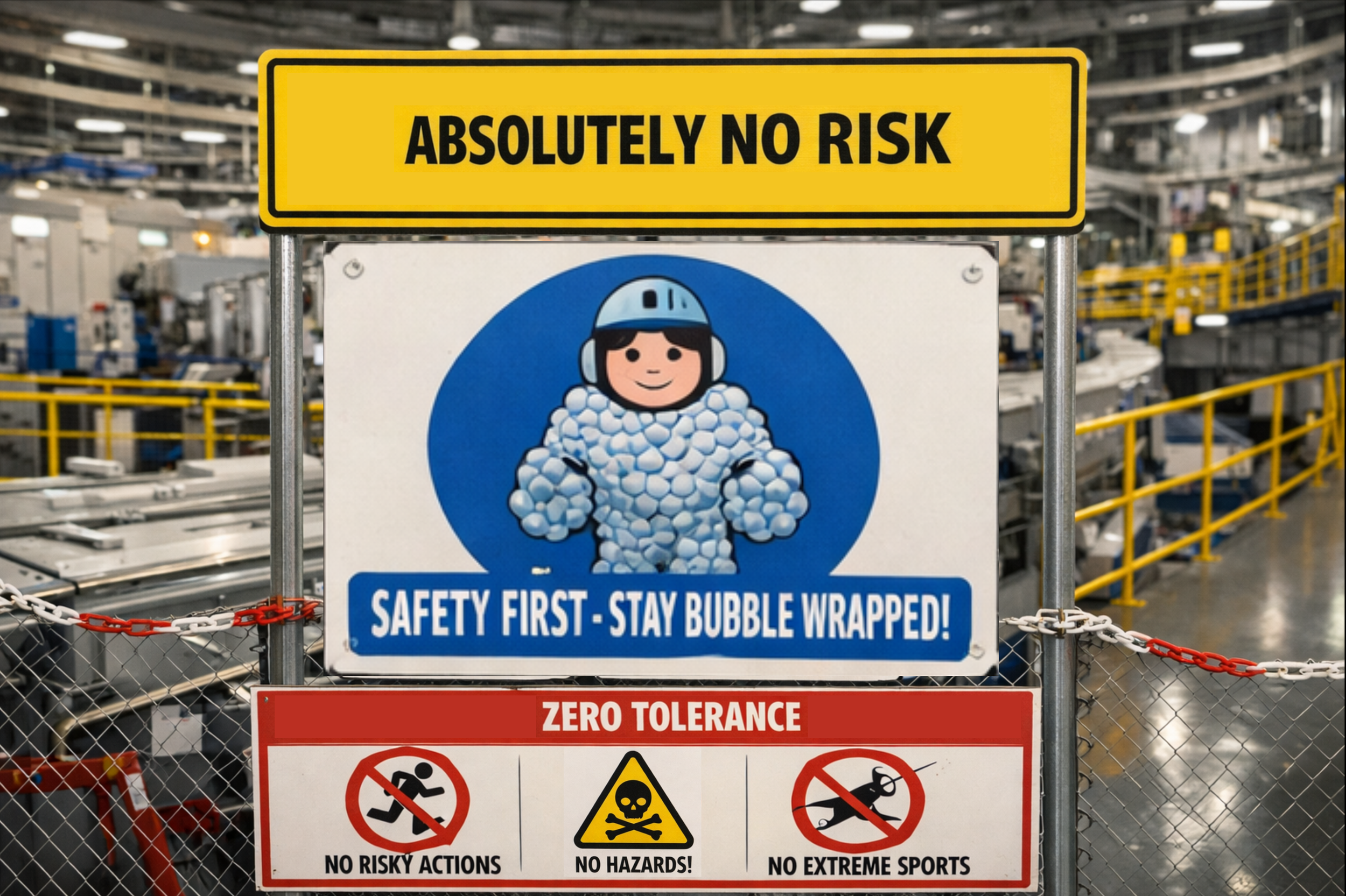
There’s No Room For Risk In The Ring
The rise of the maker community coincided with the stranglehold on creativity at work. If you read strategy documents, nobody says machine shops are failing, that we locked out the next generation, or that they no longer match experimental reality. They sound so harmless and optimistic: “Distributed fabrication,” “Rapid prototyping capability,” or, my favorite, “Empowering beamline-level engineering.” It’s what organizations write when they know something is broken. You can find this language buried in summaries at places like ESRF, ALS, and Diamond. Additive manufacturing snuck into synchrotrons.
It’s not just synchrotrons. The Maker community, I believe, stemmed from companies failing to allow creativity and failure in the workplace. In the UK, unions have excluded tinkerers from shops. In the US, people are driven out by safety police and good old-fashioned NIMBYism. Europe does a lot better at bringing young blood into the workplace and letting them work alongside talented veteran engineers. It’s significantly worse in the US national lab community, very little engineering is supported, and it’s too focused. In the US corporate world, it has generally gotten much better. There’s been a renewed focus on hardware prototyping led by the electric car and space companies we all love to hate. GE and Boeing are dead ends for innovation and have been for 25 years.
People already stopped using the central shops for most of their work needs. It’s easier, quicker, and cheaper to get things done elsewhere. Some people manufacture parts in their own garage and just don’t say anything. Others use cheap 3D printers for temporary parts that stay in place for years, almost a decade in some cases. Parts are supposed to be designed at beamlines, tested, and refined. With the current engineering situation, you’d better have it right the first time, have deep pockets, and love whatever you get. Grad students are no longer trained, scientists are no longer trusted, and fabrication literacy has eroded.
There’s still hope for the US synchrotron community, but unlike companies, they don’t live and die on merit or sales. Who makes and polishes the mirrors, the detectors, the cryo systems, the nano-precision motors? It’s not American, and that, I believe, is because there’s no room for risk in the ring.