The Isolation of American Synchrotron Science

IUCr misses the USA again
About six months ago I wrote that the brain drain to America had frozen, “put on ICE,” I said. More recently Neil deGrasse Tyson also talked about America losing its scientists, and that is getting a lot of well-deserved attention. But synchrotrons and synchrotron science also have a compounding problem that’s damaging: isolation. For instance, this week much of the crystallography world is gathering in Calgary for the IUCr Congress, a conference that has not been held in the United States since Seattle in 1996. Thirty years out in the cold. American synchrotrons remain some of the best in the world (looking at you, APS), but the scientists who actually operate beamlines and do experiments struggle to travel nationally and especially internationally, while foreign scientists have increasingly more reasons not to come here. Synchrotron science has always moved through people as much as papers: at a talk, over a beer, standing beside someone else's poster, seeing a strange piece of hardware, complaining about software, or discovering that another facility solved your problem five years ago. Institutional knowledge is Rumsfeldian; you don't know what you don't know. Europe has multiple synchrotrons separated by a train ride or a cheap flight. American facilities are separated from each other by a continent and from much of the synchrotron world by two oceans, capricious travel guidance, weird budget restrictions and opaque demonic bureaucracy. We can build brighter sources, faster detectors and better robots, but if the people running them become progressively disconnected from the international community, we risk optimizing the machines while isolating the science.
X-ray Peeps
Synchrotrons are remarkably quiet online. Where are the beamline scientists, engineers, roboticists, users and students actually talking? I keep wondering whether I'm simply looking in the wrong places, or whether the community has grown up without a shared public space at all. It feels unusual compared to almost every other part of my life—cycling, baking, surfing, rockets—where people gather online to contribute, argue, teach and learn. Synchrotrons seem almost invisible to newcomers and even to people working across the broader ecosystem. There are some exceptions. Lightsources.org is a great example, and conferences bring us together, although they're deliciously ephemeral and usually organised around techniques or specific research areas rather than the wider synchrotron world. But where is the public forum for beamline scientists, controls engineers, roboticists, data engineers, users, students and industry partners? I keep looking for it. I even created r/synchrotrons but, alas, so far it's mostly just me. This is probably a call to arms more than anything else. If the synchrotron community wants an online presence, we'll have to build it ourselves. I want r/synchrotrons to become somewhere I actually visit: a place for memes, stories, engineering hacks, software releases, ragebait, science celebrities and the kind of conversations that normally happen over coffee at conferences. One of the most collaborative infrastructures in science has no obvious public commons, talking head or news outlet for the people who actually make it work. If that place already exists, I'd genuinely love to know where it is.
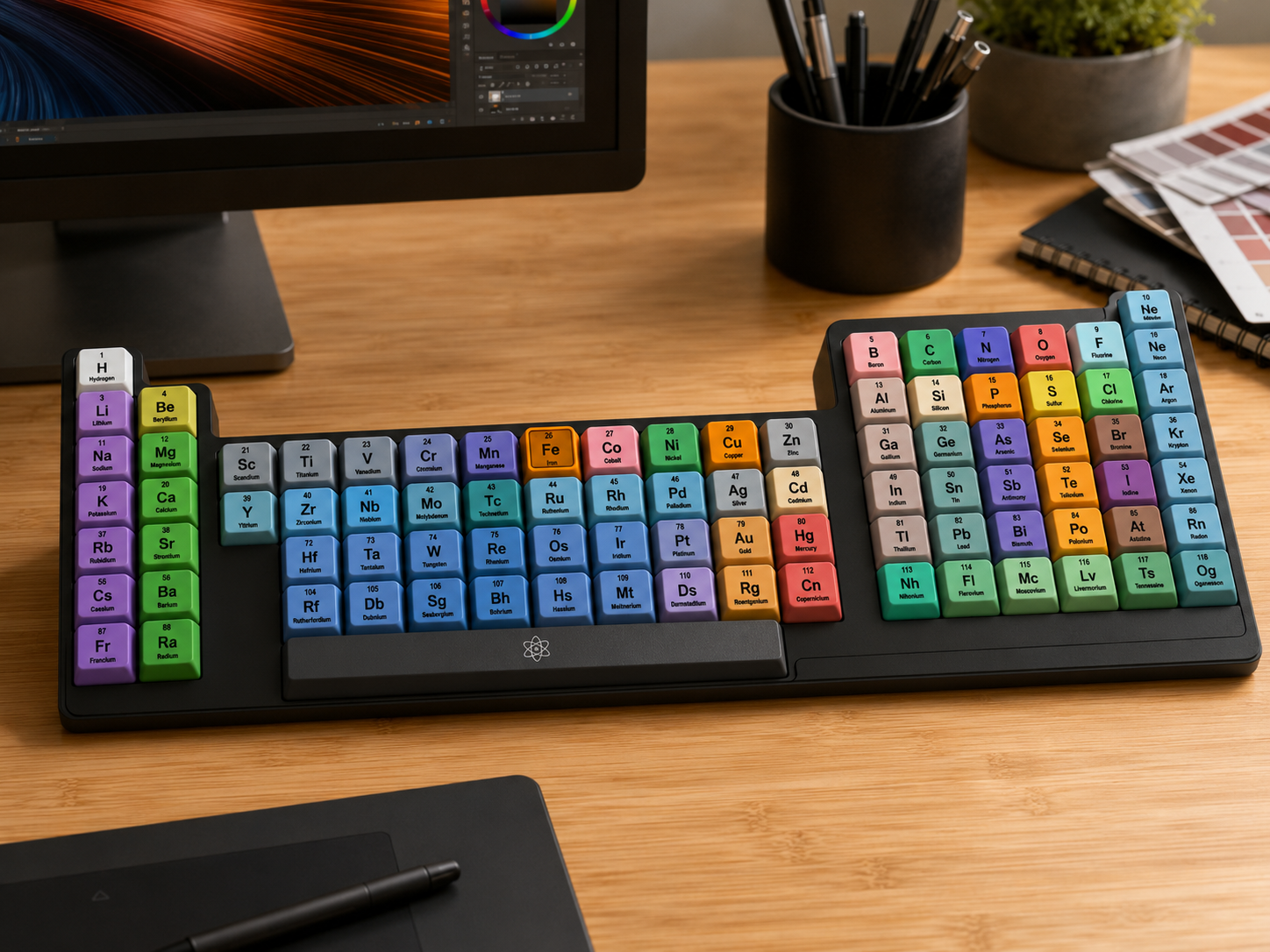
The Orange Bible
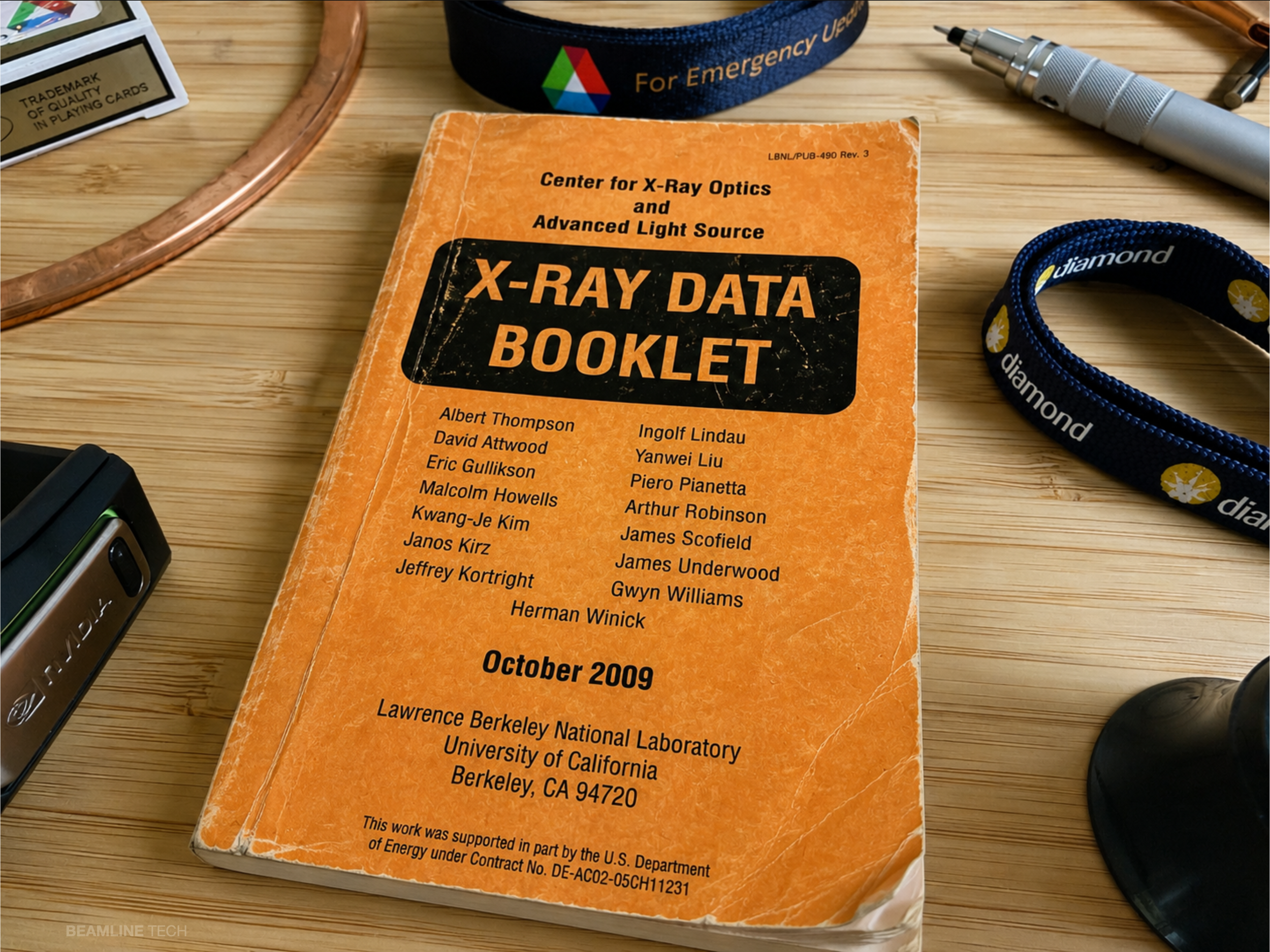
X-ray Data Booklet
The little orange booklet is probably one of the most successful pieces of scientific documentation ever written.
I realised it when every visiting scientist who came to the beamline picked it up to look up absorption edges. There are so many numbers packed into that tiny booklet that almost nobody remembers more than a handful of them. Every experiment seemed to involve someone reaching for it. I've never seen a pristine copy at a beamline, not a one. The most useful documents have broken spines, folded pages, coffee stains and handwritten notes, and some have no cover left at all.
I eventually persuaded Al Thompson to sign my own copy. Al was the lead author, and we worked together briefly at Beamline 4.2.2 in Berkeley in the early 2000s, back when ALS still printed boxes of them and reading things made of paper was still quite common.
Scientists would constantly try to take the beamline copy home with them but we'd redirect them to the stack in the ALS lobby where visitors could pick one up. In hindsight it was a brilliant piece of outreach and indirect advertising. Hundreds upon hundreds of little orange ambassadors spread around the world, an X-ray information diaspora. Each one ending up who knows where.
The last revision I’ve ever seen was printed in 2011. Some ALS conference booths still hand them out if you're lucky. I don't know of another scientific reference that has survived this long, remained this relevant and become this well loved.
There is something deeply satisfying about flicking through the tiny booklet. When I started building X-ref, I wasn't trying to replace the orange bible, that would be impossible. What I wanted was to make the modern version, the information available wherever you happened to be (it’s designed to work offline). Cleaner, faster than the book and as delightful as digital can be, you know, something genuinely useful. Version 1 will be available in the next week or two on iPhone. I would have preferred to give it away for free and I tried to find a synchrotron or company willing to sponsor it, but I couldn't make that work. Instead I've priced it as low as I can while still being able to keep improving it. Hopefully version 2 will be the real leap forward but more about that another time.
In the meantime, I'd love to know how you got your orange book and where it is now. Other than the X-rays themselves, it is probably the one common thread amongst all of us beamline folks.
Negative Feedback Is A Signal

Is there a problem in the pipeline that produces the synchrotron people who do the experiment? The people who build synchrotron science are increasingly visitors to it and often their first encounter of the facility is after they have already chosen their field. Every discussion about the future of MX eventually turns into a discussion about technology. We spend an enormous amount of time asking how to make the experiment better. Cryo-EM put a super microscope in the university department, synchrotron scientist still get put on planes.
Cryo-EM became an incubator. The advantage of Cryo-EM is convenience, and the less obvious advantage is innovation. When the microscope lives in the building, students use it and engineers modify it. Software developers test ideas, and small improvements spread quickly because the users and builders occupy the same ecosystem.
A synchrotron upgrade is a national project. One costs billions, the other might cost a few hundred thousand dollars and spread around the world within a year. This creates a fundamentally different rate of evolution.
The other advantage Cryo-EM enjoys is that much of the conversation happens close to the users. Universities are messy places. Students, postdocs, and PIs complain. Software gets criticized in public, and workflows get challenged. Somebody always points out what is not working.
National labs are different. Almost every public-facing communication is filtered through management, communications teams, committees, and institutional priorities. That's understandable. These are billion-dollar facilities funded by taxpayers and governments. However, negative feedback is a powerful signal. If every report is positive, every upgrade is transformative, and every workshop is a success, it becomes difficult to distinguish genuine progress from institutional optimism. We've all done it, we've all seen it, and we all know everyone else is doing it too.
One of my bugbears about synchrotrons is that there is still no obvious public place where beamline scientists can openly discuss what isn't working. No equivalent of the conversations happening in departments, labs, and graduate offices around the world. The closest thing we have are conferences, and those only happen a few days a year. And if you're unlucky enough to be a scientist at an American institute, getting travel approved to mingle with foreign peers is next to impossible.
The irony is that MX solved many of the technical problems that used to limit growth. Remote access, automation, robotics, etc. Pharmaceutical fragment screening has never been more productive.
The experiments keep getting better and synchrotrons are still at the bleeding edge (and the most fun), but they need more visibility to the public and to each other. Incubators nearer to the devices.
I'd be curious whether this looks different from outside the US. When Rutherford and Diamond started putting Cryo-EM facilities next to the synchrotron, I thought they looked like headstones for a dying X-ray method. On reflection, it might be the smartest thing they ever did. Keep your enemies close and all that.
The Old Beamline GUIs Are Holding Back General Pipelines
Why do most beamlines insist on asking me where I want to save my data? The beamline already expects me, knows what proposal I'm on, and knows where the last thousand datasets went. It's a small complaint, but I think it belies a bigger problem.
Most beamline control GUIs were designed around a person sitting in front of a workstation running a single experiment. At least on non-MX beamlines. Move a motor. Open a shutter. Collect data. Save. Repeat. Repeat again. There is nothing inherently wrong with this, as it worked so well for so long. I just don't think we can bring this into Gen 4 synchrotrons.
The good news is that many new beamlines are no longer running individual experiments; they're running pipelines and series of experiments. Lots of repetition, and the experiment is often the shortest part of the entire workflow.
Yet we still ask users questions the beamline already knows the answer to. Some of these questions made sense twenty years ago. Some even made sense five years ago. Software companies and manufacturers figured out the goal isn't to give users choices. The goal is to make the right thing happen automatically. The best systems are predictable, where self-similar inputs are treated similarly by the pipeline and produce similar outcomes.
Reproducibility is a foundation of science and a relatively new feature at many beamlines. Robots and pipelines are better, storage is cheap(ish), and Covid normalized remote access. We know far more about how users actually interact with facilities than we did a decade ago, and I think that's a big win.
High time we revisit some of the old assumptions and make sure we are putting humans in the correct part of the experiment cycle. Less remembering where files belong, more time designing, validating, improving workflows, and hunting down mistakes before they propagate.
If you could delete one pointless ritual from facility life, what would it be?

Beamlines Are Software Incubators
Beamlines are not run like software companies, but they are perfect incubators for big ideas. They face a constant stream of challenging tasks, with outcomes expected quickly. They take inputs, execute pipelines, handle failure, and return outputs. Analysis is on demand, frequently written up, with copious notes shared freely on GitHub and in published papers.
Samples go in, data comes out, and the whole system is stitched together by code, often written in isolation without test-driven development, a CLI, a product manager, or explicit customer demands. Frequently, the coder is also the end user. I know because I’ve done it myself. Is it ideal? Probably not. But the delta between feature or bug and patch is small. The code grows organically around the problem, solving it and protecting the user from the ugliness beneath. More often than not, it is not well written, badly optimized and works perfectly well.
We still talk about “experiments” as if they are one-off events, but most beamlines run similar workflows tens or hundreds of times a day. That is not science in the old sense. Decisions are increasingly made inside the system itself. For synchrotron experiments the beam is just one part, but if you are running your experiment correctly, it should be the rate-limiting step. You want to be using all your X-rays and asking for more synchrotron.
The facilities that move fastest will treat experiments like a stack, beamlines as modules. And align the goals of the beamlines with the goals of the science questions.
I am as guilty as anyone of running an experiment just because it is fun. And like successful software companies, you need to give people space to flex imagination and discover skills you did not know you needed.
Let them cook … or incubate.

The Brain Drain to America Has Frozen
The science diaspora has stopped moving into America. Travel outside the US has become impossible for American scientists, and you risk ruin if you are an immigrant-American scientist. At the same time, foreign scientists have strong incentives not to travel into the US. From the outside, America has long appeared dangerous and violent, particularly from a European perspective. Nearly every country has its headline story of a tourist being detained, harassed, or killed. This is not a new problem, and it predates the current administration. But recent policy has poured gasoline on it; a more appropriate metaphor might be that it’s frozen, it’s on ICE.
Add visible xenophobia, aggressive immigration enforcement, and overtly anti-science policy, and you create an environment where saying goodbye to your spouse before going to an American conference feels like a risk calculation. The presence of ICE with broad detention authority does not encourage scientific exchange. “Broad detention authority” is doing a lot of work in that sentence.
When I moved from Diamond to APS, I was under the impression that I could continue attending international conferences. When in the UK, I traveled extensively. Conferences were where ideas and techniques jumped borders, and where you learned what people were actually doing rather than what they eventually wrote up. But I was wrong, and a little misled.
In the US synchrotron system, the people who actually do the experiments rarely travel. Conference attendance is reserved almost exclusively for group leaders, grant writers, and senior PIs. And as everyone in US science knows, grant writers are not the people thinking about and doing the experiments; they’re just in charge of the money. PIs are writing grants and papers and reporting to the infinite hierarchy above them.
This matters because the US synchrotron ecosystem already relies heavily on imported expertise. That pipeline is dry. Almost all major synchrotron equipment is manufactured outside the US, with a few notable exceptions like Mitegen (by the way, I’m not happy that the Bills beat the Jaguars yesterday). For decades, we compensated for this by importing people. Talent came here because pay was better, facilities were strong, and the ecosystem rewarded ambition.
American scientists are still paid better than their counterparts elsewhere, and that has helped keep talent here. But money cannot buy ideas, experience, or the kind of institutional knowledge that only emerges through repeated, informal interaction with a global community. And institutional knowledge is opaque from the outside. If you are not embedded in those conversations, you do not even know what you are missing.
So we remain hamstrung by travel budgets and crazy strict regulations, bizarre administrative barriers, and now geopolitical reality. We cannot easily go out to get ideas, and increasingly, ideas will not come to us. For the foreseeable future, nothing fundamental is going to change. The quiet isolation of American synchrotron science will continue. For shame.

There’s No Room For Risk In The Ring
The rise of the maker community coincided with the stranglehold on creativity at work. If you read strategy documents, nobody says machine shops are failing, that we locked out the next generation, or that they no longer match experimental reality. They sound so harmless and optimistic: “Distributed fabrication,” “Rapid prototyping capability,” or, my favorite, “Empowering beamline-level engineering.” It’s what organizations write when they know something is broken. You can find this language buried in summaries at places like ESRF, ALS, and Diamond. Additive manufacturing snuck into synchrotrons.
It’s not just synchrotrons. The Maker community, I believe, stemmed from companies failing to allow creativity and failure in the workplace. In the UK, unions have excluded tinkerers from shops. In the US, people are driven out by safety police and good old-fashioned NIMBYism. Europe does a lot better at bringing young blood into the workplace and letting them work alongside talented veteran engineers. It’s significantly worse in the US national lab community, very little engineering is supported, and it’s too focused. In the US corporate world, it has generally gotten much better. There’s been a renewed focus on hardware prototyping led by the electric car and space companies we all love to hate. GE and Boeing are dead ends for innovation and have been for 25 years.
People already stopped using the central shops for most of their work needs. It’s easier, quicker, and cheaper to get things done elsewhere. Some people manufacture parts in their own garage and just don’t say anything. Others use cheap 3D printers for temporary parts that stay in place for years, almost a decade in some cases. Parts are supposed to be designed at beamlines, tested, and refined. With the current engineering situation, you’d better have it right the first time, have deep pockets, and love whatever you get. Grad students are no longer trained, scientists are no longer trusted, and fabrication literacy has eroded.
There’s still hope for the US synchrotron community, but unlike companies, they don’t live and die on merit or sales. Who makes and polishes the mirrors, the detectors, the cryo systems, the nano-precision motors? It’s not American, and that, I believe, is because there’s no room for risk in the ring.

Don’t Upgrade the ALS, Build a New Synchrotron in Florida Instead
The next American light source shouldn’t be an upgrade, it should be a clean start. Upgrades preserve jobs, history, and infrastructure, but they also preserve outdated beamlines, allocation models, and science priorities. The most strategically useful thing a synchrotron can do now is high-throughput tomography. Imaging that serves large scales and small materials, batteries, chips, integrated circuits, critical minerals, and radiation environments found in space. Imaging that doesn’t need a hero PI (sorry readers I know thats probably you) to get funded, one that supports real products and their timelines.
Florida is the right location in my opinion. It sits inside a growing aerospace and materials corridor. SpaceX, Blue Origin, defense contractors, battery startups, chip fabs … all of them need CT infrastructure that doesn’t exist yet. They need repeatable, reliable and predictable access not shifts built on grants and distributed by ancient beaurcracy. User support as part of the product, not as a favor. It should not be another national facility trying to serve everyone equally. It should serve the problems that are immediate. Built for industry workflows, scheduled and integrated. Contracts. Pay-per-sample. Ubiquitous formats, queueable, reconstructable, programmable. All the things that synchrotron are currently not. Leave exploration to the other synchrotrons. And demand for this already exists with companies like Lumafield, Sigray, Zeiss, Glimpse that are scaling the mid-tier while currently the high end still belongs to the synchrotrons. Give them each a corner of the ring and let them duke it out, let them buy and sell ports on the open market.
Upgrades won’t get us there. Everyone that works at a national lab with a synchrtron knows how deep the ruts in the road already are. $1B modernization of the shell still leaves the incentives in place: the beamlines get better but serve the same legacy. The pandemic helped prove what science can do when its sigularly focused. If national competitiveness is a real priority, this is where it starts. Synchrotrons turn inspection into insight and validate materials, confirm assemblies, raise the floor for every sector that builds anything. Let ALS and SSRL age out, or continue with what they do best. Let Florida build the machine we actually need, the one that NSLS II and APS-U really don’t want to do … the yucky business stuff.

AlphaFold Didn’t Kill MX but 4th-Gen Synchrotrons Will
Every time a synchrotron moves from 3rd to 4th gen, the number of relevant MX beamlines users drops, the whole thing is on life support.
MX beamline were not out done by AlphaFold because they still had inertia. But the real killer will not come from AI, it comes from the ring upgrades. When a synchrotron shuts down for an upgrade, people say one year but it’s actually about two. In that time, MX users disappear, they ship crystals somewhere else and figure out how to work remotely. When the light comes back on, many never return. What replaces them isn’t a new generation. It is no generation.
In the U.S, the human capital for MX is drying up, there’s no cohort of 25-year-olds begging for 2 a.m. beamtime slots. The few that remain drift into analysis, modeling, or commercial R&D. MX in America is mostly carried by an older generation with habits that predate modern detectors. How many of the old guard still collect data at 1 degree per sec? At 4th gen synchrotron thats like asking a supersonic jet to taxi across the Atlantic. And yet the beamlines keep getting better: I bet the last horse-drawn carriage was a real beauty too.
So what is MX now? It’s confirmation. Fold-checking. We helped build AlphaFold’s training data (it seems so unfair) Room temperature dynamic, that’s real, that could carry forward. But it’s not what most beamlines are set up to do, and the US community that might do it isn’t really there yet.
Fragment screening is the diamond in the experiment rough, pharma wants answers. XChem thrives, creating the training data that will be its demise as well. But another wave is coming for them too. Faster tools, better proxies, AI-led design. When that hits, “screening” will need a new defense, confirmation machines like the rest of MX probably
The 4th generation of beamlines will still be here. The question is which science deserves the space, and should it be MX.

Where Is the Synchrotron Community Online
For a group of facilities that sit at the center of modern scientific progress, synchrotrons have a surprisingly quiet online presence. At least, that is how it looks from the outside and, more crucially, from the inside too. I sometimes wonder if I am simply missing the places where people gather, or if the community has grown up without a shared public space at all. It feels unusual compared to almost any other part of my life: cycling, baking, surfing, rockets. We are catered to and we contribute to all of these online. We are entertained and educated, amused, outrage baited, and given endless “news” articles that we happily consume. Many scientific fields have a natural home on the internet. Synchrotrons seem invisible to newcomers and to people working across the broader ecosystem. Small pockets exist, working groups, collaborators, Slack channels, but nothing that feels like the whole picture.
There are a few structures that give the impression of community, although none of them feel like the real thing. Lightsources.org is a good example. It is one of the most complete sources of announcements and stories, but it functions more like a broadcast channel than a gathering place. Conferences bring people together, although they are usually organised around techniques or specific research areas rather than the wider synchrotron world. Where is the beamline scientist conference where we celebrate how to best herd cats? Email lists and facility blasts work well for people already inside the network, but they reach only the people who already know to subscribe. Are we still reading emails? I keep asking myself if there is a public forum for beamline scientists, data engineers, roboticists, users, students and industry partners to contribute and consume. If it exists, I have not found it yet. If it does not, why not.
This leaves a strange gap. I want an MKBHD of new beamline equipment, I want r/synchrotrons to be a place I go to, I want memes. One of the most collaborative infrastructures in science has no obvious online gathering point, talking head or news outlet for the people who make it work. Ideas spread slowly and each facility grows its own conventions (even between beamlines at the same facility). I am curious if others see the same thing. Is there a community space I have missed? Does a global conversation already happen somewhere that newer scientists cannot see. Or is this simply a field that has not yet built its own public commons. If you know the answer or have ideas, it would be good to understand what exists and what is still missing.

Engines of National Competitiveness
Synchrotrons have become one of the most quietly influential technologies in modern science. In the last 40 years they shifted from specialised physics machines into the backbone of entire sectors driving the modern economy, such as energy storage, aerospace, semiconductors, pharmaceuticals and cultural heritage. Not to mention our understanding of biology. Any field that depends on structure, reliability and real scientific understanding eventually finds its way to a synchrotron. This transformation happened gradually, infecting universities and companies as facilities around the world turned brilliant light into industrial insight.
The turning point was the operational discipline and scientific method writ large. Beamlines learned to run like production environments with workflows that emphasised predictability, clarity and repeatability. Automated sample changers, real time reconstruction pipelines and stable software practices became the norm and reomote automation exploded during the covid era. Experienced staff became engines of throughput. What used to be episodic experiments became routine and schedulable processes. Behind the scenes that shift created the scale that companies and industries can build strategies on.
Very few people outside the community talk about what this means for national competitiveness. Synchrotrons provide a place where ideas can be validated, generate high quality data and raise the floor for whole communities. Nations invest in factories and innovation hubs and synchrotrons function as both. If we want a clear picture of the future of competitiveness, it might be time to alert the public that these facilities are strategic assets and they have been quietly shaping the landscape for decades. With that in mind: where is the synchrotron online community and our voice in the deafening onslaught of online science educators?
Focus of the New Florida Synchrotron, A Source For Industries
If Florida builds its new synchrotron (The Beach), it shouldn’t try to copy the existing playbook. The real opportunity is in commercial tomography: high-throughput 3D imaging that industries already need, but can’t access at scale. Every modern ring can do great science; very few have figured out how to turn their tomography beamlines into genuine engines for economic output. The Beach (Brightest Ever ACHromat) synchrotron can skip the slow part and build directly for commercial value, predictable throughput, pay-to-play automated workflows, and industry-ready products.
Right now, battery companies, aerospace groups, chip fabs and materials labs are all bottlenecked by CT capacity. Florida has a future untapped space industry that will need tomography and radiation-tested equipment. Industrial CT scanners can’t match the speed or resolution of a synchrotron and definitely not a one geared for the needs of the community with whole sectors dedicated to different Tomography regimes (macro, micro, nano, 3D, 4D, time-resolved and laminography). But almost no facility offers an access model designed for industry. Beamtime allocation is still structured for fairness, not throughput or return on investment (ROI). That’s the gap: if The Beach positions tomography as a service, with automated real-time reconstruction, it a public-private partnership win-win.
A new ring in Florida’s tech corridor has many strategic advantages, the greatest of which is that it isn’t burdened by legacy. It can build an allocation system aligned with product development, not just paper proposals. It can integrate robotics, AI reconstruction, and industrial data formats from day one. And it can court the growing wave of commercial tomography companies (Lumafield, Sigray, Glimpse, Zeiss Xradia) looking for partnerships. If Florida wants a synchrotron that actually drives regional innovation, tomography is the clearest, most investable way to get there a bridge between science and a source for industries that need it. The Beach should be built for the next 50 years of industry, not the last 50 years of academia.

Serial Crystallography Is More Scientific
Many good careers have been dashed against the rocks by chance, and a fair few have been made by luck alone. The real shift underway is toward systems that generate the same answer every time. Time-resolved and serial crystallography are shaping expectations in X-ray science because it forces this consistency. As experiments become faster, more automated, and eventually more driven by AI and robot sample exchangers performing the same motions thousands of times, reproducibility stops being a scientific value and becomes a product discipline. The product is a high quality, room tempreature low-dose structures, a little snapshot of time. The precision needed for that outcome pushes every part of the workflow to behave predictably from loading to alignment to analysis. It makes the field a preview of things to come. The days of one heroic crystal making or breaking a graduate student should be behind us, replaced by systems that are reliable, repeatable and fair.

Ayo Deathstar
For serial crystrallography experiments we always pick a theme and go in strict alphabetical order, and it makes the whole process both cleaner and more fun. Each chip gets one of these names (Anakin, Battlestar, Chewie or Ayo, Bet, Chopped), and it works as a reference point, a kind of mental anchor, for objects that are otherwise visually identical. The long-range order of the alphabet lets us perceive the experiment moving forward in real time, and it gives future-us an immediate sense of the exact sequence the chips followed on the day.
But no diagram teaches you more about HPC pipelines than working at the beamline and actually needing one. An experiment only works when everything works in concert, and that goes from nodes handing off tasks cleanly to robots, motors and detectors doing the same.
Speed is irrelevant if the system is messy and mysterious. Clean naming and decision points matter. Clarity matters as much as anything and predictability is priceless. Beamline experiments tend to succeed through clear coordination, adaptability and steady operational discipline, and that same mindset is what will make distributed HPC pipelines work in practice.

Data-responsive Labs (AI)
We might already have a working version of “AI-driven research” inside beamlines, in the form of fully data-responsive labs.
At synchrotrons, beamline automation has quietly become a real-world model of data-driven discovery. Robots, detectors, and analysis software already operate within a closed feedback loop. A robotic arm mounts a sample, data are collected and analyzed in real time, and the system, currently guided by a person, determines the next action. It is not just automation for efficiency; it is automation for decision-making.
That loop (data → robot → experiment → analysis → data) runs as long as there is light, hundreds of times a day, at hundreds of beamlines at tens of facilities around the world. In effect, beamlines are living examples of how feedback becomes action, with humans guiding rather than blocking the flow. What many AI and automation projects are still trying to build from scratch, beamlines have been refining for years.
If the broader R&D community wants to understand what genuine programmatic discovery looks like, it might be worth studying how beamlines already function. They bridge research and implementation in a way that is both practical and scalable.
It feels like an idea worth developing, especially at the intersection of automation and scientific decision-making.
